
- 詳細內容
- 分類:活動訊息
徵稿啟事
2019年 TAERE 台灣環境與資源經濟學會年會
時間:民國108年12月14日8:30-17:40
地點:輔仁大學 (新北市新莊區中正路510號)
親愛的會員:
2019年台灣環境與資源經濟學會將於民國108年12月14日
在輔仁大學(新北市新莊區中正路510號) 舉行年會,
我們誠摯的邀請您投稿環境與資源經濟的理論與實證文章。請由此處前往投稿。
議題與發表語言
與環境與資源經濟學相關之理論、實證、政策議題皆歡迎。
本次會議將同時包含中文及英語發表場次,亦開放海外專家學者投稿報名參加。
投稿指南
投稿摘要請勿超過兩頁,
投稿全文須包含文章標題,作者姓名,研究主題,研究方法,主要發現以及參考文獻。
每篇文章中至少其中一位作者需為本會會員,國外專家學者除外。
重要時程
- 摘要投稿至民國108年10月13日止。(延長至108年10月31日止)
- 審稿結果將於民國108年10月31日通知。
- 全文投稿至民國108年11月15日止。
交通與住宿
會場鄰近台北捷運新蘆線輔大站。
期待於2019年台灣環境與資源經濟學會年會與您相見!
敬祝
平安 快樂
大會主席 胡均立 教授
主辦單位:台灣環境與資源經濟學會
合辦單位:國立交通大學經營管理研究所
國立臺北大學全球變遷與永續科學研究中心
台灣低碳社會與綠色經濟推廣協會
報名程序:
欲報名者請前往報名網址,線上報名完成後請繳交年會出席費。
出席費:費用包含會議材料費、茶點費、午餐費。
- 台灣環境與資源經濟學會會員:免費(歡迎加入成為會員)。
- 非會員:每人台幣2,000元。(論文發表人若非本會會員,仍須另行繳交出席費。)
繳費方式:
銀行轉帳,請註明個人姓名或公司名稱,並請掃描存根聯,以電子郵件方式寄至:Email住址會使用灌水程式保護機制。你需要啟動Javascript才能觀看它。
銀行轉帳資訊
- 戶名:社團法人台灣環境與資源經濟學會
- 金融單位:【玉山】銀行【民權】分行,銀行代碼808
- 帳號:0598-940-015946
任何關於年會的問題可聯絡大會秘書處,電子信箱:Email住址會使用灌水程式保護機制。你需要啟動Javascript才能觀看它。
- 詳細內容
- 分類:活動訊息
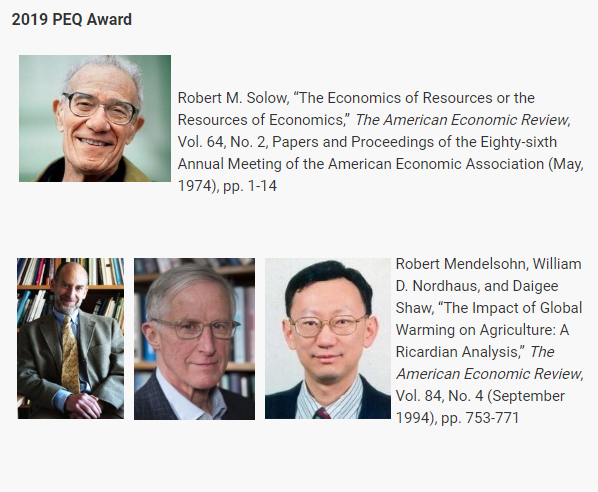
環境與資源經濟學會(Association of Environmental and Resource Economists,AERE)1989年起,每年皆會頒發Publication of Enduring Quality(PEQ)Award。
2019年PEQ Award受獎作品共兩篇,其中一篇為本會創會理事長蕭代基教授與Robert Mendelsohn教授以及William D. Nordhaus教授合作之著作:
Mendelsohn, R., Nordhaus, W. D., & Shaw, D. (1994). The impact of global warming on agriculture: a Ricardian analysis. The American economic review, 753-771.
此篇文章對環境與資源經濟領域具有開創性與持續價值的卓越貢獻。
- 詳細內容
- 分類:暑期課程資訊
本篇收錄2019年暑期課程的影片記錄,共八段
Course 1: Main issues and problems of pollution and resource depletion (part 1)
2019 Summer School on "Environmental Footprints"
Organizer: Taiwan Association of Environmental and Resource Economics (TAERE)
Date: 2019/7/15 Morning
Opening Speech:
Daigee Shaw, President of TAERE
Kamhon Kan, Research Fellow and Director, Institute of Economics, Academia Sinica
Lecturers:
Jiří Jaromír KLEMEŠ, Brno University of Technology, Czech Republic
Petar Sabev Varbanov, Brno University of Technology, Czech Republic
Video Timeline:
00:00 Opening
07:46 Course outline
18:26 Introduction – main issues and problems of pollution and resource depletion
Course 2: Main issues and problems of pollution and resource depletion (part 2)
2019 Summer School on "Environmental Footprints"
Organizer: Taiwan Association of Environmental and Resource Economics (TAERE)
Date: 2019/7/15 Morning
Lecturers:
Jiří Jaromír KLEMEŠ, Brno University of Technology, Czech Republic
Petar Sabev Varbanov, Brno University of Technology, Czech Republic
Video Timeline:
Course 3: Environmental impacts, interactions, foundations of circular economy (part 1)
2019 Summer School on "Environmental Footprints"
Organizer: Taiwan Association of Environmental and Resource Economics (TAERE)
Date: 2019/7/15 Afternoon
Lecturers:
Jiří Jaromír KLEMEŠ, Brno University of Technology, Czech Republic
Petar Sabev Varbanov, Brno University of Technology, Czech Republic
Video Timeline:
00:00 Natural resources and their natural storages – circularity of extraction, use and discharge
28:55 Circular Economy principles and strategy
Course 4: Environmental impacts, interactions, foundations of circular economy (part 2)
Organizer: Taiwan Association of Environmental and Resource Economics (TAERE)
Date: 2019/7/15 Afternoon
Lecturers:
Jiří Jaromír KLEMEŠ, Brno University of Technology, Czech Republic
Petar Sabev Varbanov, Brno University of Technology, Czech Republic
Video Timeline:
00:00 Global energy and (virtual) water flows – the scale of the flows and the problems
38:39 Sustainability – definition, components and metrics
1:00:10 Life Cycle thinking and the LCA framework
Course 5: Environmental Footprints – Introduction, definitions, implementation
2019 Summer School on "Environmental Footprints"
Organizer: Taiwan Association of Environmental and Resource Economics (TAERE)
Date: 2019/7/16 Morning
Lecturers:
Jiří Jaromír KLEMEŠ, Brno University of Technology, Czech Republic
Petar Sabev Varbanov, Brno University of Technology, Czech Republic
Video Timeline:
00:00 The Environmental Performance Strategy Map
22:25 Direct, indirect and total effects
35:52 General footprint principles and concepts
1:10:04 GHG (Carbon) footprint
1:18:52 Water footprint
Course 6:Environmental Footprints – Introduction, definitions, implementation
Organizer: Taiwan Association of Environmental and Resource Economics (TAERE)
Date: 2019/7/16 Morning
Lecturers:
Jiří Jaromír KLEMEŠ, Brno University of Technology, Czech Republic
Petar Sabev Varbanov, Brno University of Technology, Czech Republic
Video Timeline:
00:00 Water footprint
12:07 Energy footprint
48:05 Nitrogen footprint
Course 7: Environmental Footprints & GHG/Haze Footprint Minimization
2019 Summer School on "Environmental Footprints"
Organizer: Taiwan Association of Environmental and Resource Economics (TAERE)
Date: 2019/7/16 Afternoon
Lecturers:
Jiří Jaromír KLEMEŠ, Brno University of Technology, Czech Republic
Petar Sabev Varbanov, Brno University of Technology, Czech Republic
Video Timeline:
00:00 Other footprints
23:14 Virtual footprints
1:19:07 GHG and Haze Footprint Minimisation
Course 8: Introduction to Heat Integration and Pinch Analysis
Organizer: Taiwan Association of Environmental and Resource Economics (TAERE)
Date: 2019/7/16 Afternoon
Lecturers:
Jiří Jaromír KLEMEŠ, Brno University of Technology, Czech Republic
Petar Sabev Varbanov, Brno University of Technology, Czech Republic
Video Timeline:
00:00 Introduction to Heat Integration and Pinch Analysis
《TAERE 2019: Records of Summer School》
- 詳細內容
- 分類:暑期課程資訊
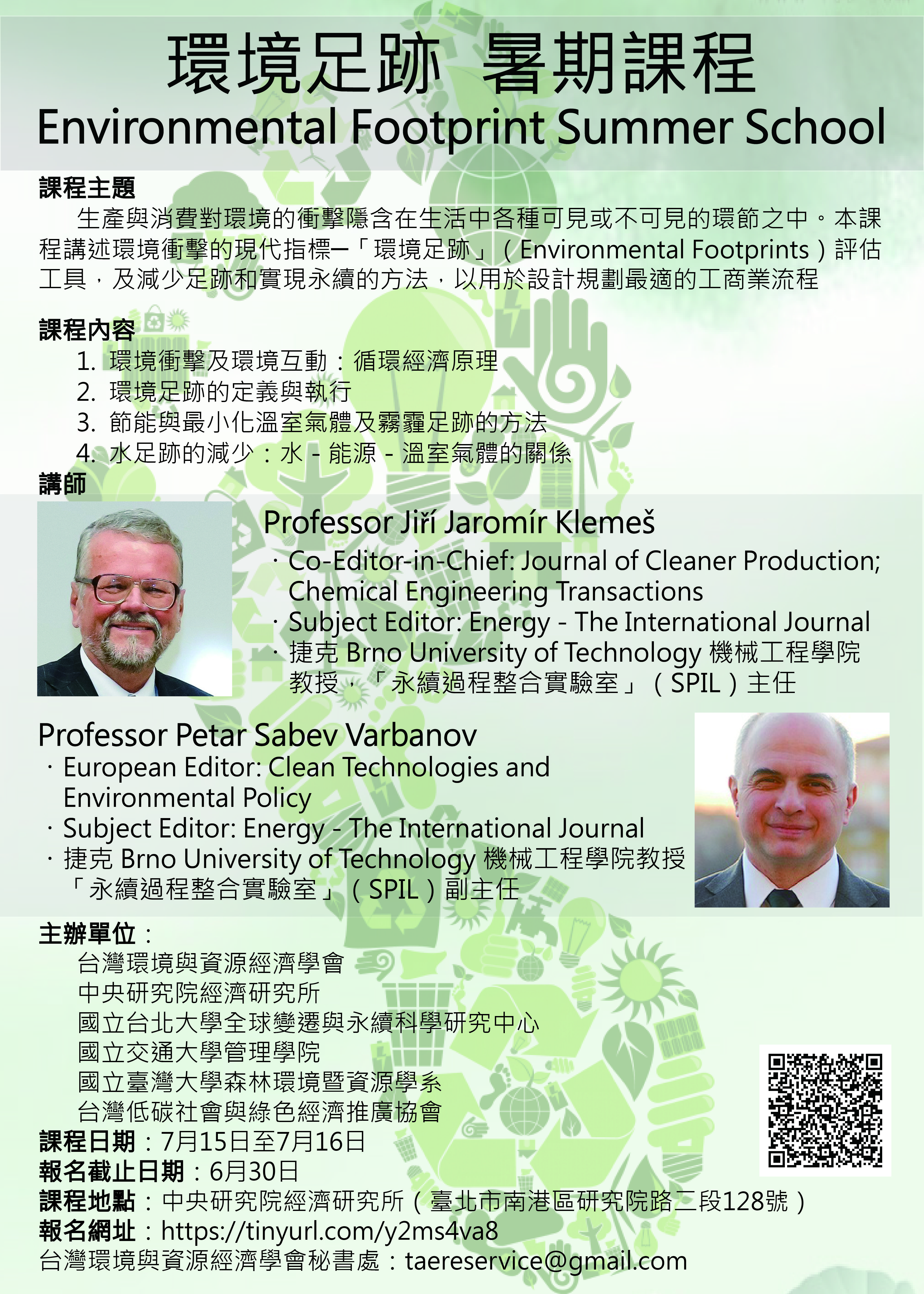
July 15-16, 2019
Organizers:
- Taiwan Association of Environmental and Resource Economics
- Institute of Economics, Academia Sinica
- Center for Global Change and Sustainability Science, National Taipei University
- College of Management, National Chiao Tung University
- School of Forestry and Resources Conservation, National Taiwan University
- Taiwan Association for Low Carbon Society an Economy
Venue: Institute of Economics, Academia Sinica, 128 Academia Road, Section 2, Nankang, Taipei, Taiwan
DEADLINE FOR APPLICATION: June 30, 2019
 |
|
 |
Professor Petar Sabev Varbanov
|
Abstract
The course offers an overview of the modern metrics of environmental impact, called "Environmental Footprints," and the methods for their reduction and achieving sustainability. Environmental Footprint assessment tools are very useful for optimising the performance of industrial and business processes. Often they are also referred to as "Ecological Footprints."
The course has several major parts:
Part 1. Introduction to environmental impacts and interactions, foundations of Circular Economy
This part introduces the topics, starting from a discussion of the main issues and problems of environmental pollution and depletion of natural resources from their natural storages. The emphasis is put on the need for circularity of the resource use and product/by-product reuse, and implementing the Circular Economy principles and strategy, to minimise resource extraction and waste discharge.
Definitions of sustainability and sustainable development are given. The Life Cycle thinking and the fundamentals of Life Cycle Analysis (LCA) are introduced, distinguishing between direct, indirect and total effects. The part includes the Environmental Performance Strategy Map – a concept that allows visualising and simultaneously optimising the environmental and economic performance indicators of human activities – an industrial site or other business activities.
The part concludes with the main principles and indicators important for measuring environmental impacts.
Part 2. Environmental Footprints – Introduction, definitions, implementation
This part introduces in more detail the key footprints, important for evaluating and altering the performance of industrial, business and societal systems in terms of environmental impacts and sustainability. The indicators include those for Greenhouse Gas (GHG), Water Footprint, Nitrogen Footprint, and others. The part concludes with presenting the possible measures and degrees of freedom to reduce footprints.
Within that context, the global energy and water flows are overviewed, including the flows of Virtual Water and Virtual GHG Footprints.
Part 3. Methods for Energy Saving and GHG and Haze Footprint Minimisation
This part starts by discussing case studies that provide examples of the benefits from concerted strategies for Energy Saving and further measures for GHG/Haze Footprint minimisation. The Process Integration principle is explained, clearly showing its coherence with the resource/waste hierarchy and the use of renewables as a footprint reduction tool. That is followed by the concepts, principles, and methods of Heat Integration and Pinch Analysis, for the simultaneous reduction of footprints and resource intake. The techniques include Data Extraction, Heat Recovery Targeting, Design of Heat Exchanger Networks, integration of energy-intensive processes, Total Site Heat Integration, Advanced Process Integration Techniques and energy storage methods, for improving the energy savings.
Part 4. Reduction of Water Footprint, Water-Energy-GHG Nexus
This part provides an introduction to Water Integration and nexus considerations. It starts with Data Extraction concerning water use, Water Network Design, discussion of water quality issues and implications, Water Pinch Analysis, water system analysis, Maximum Water Recovery Targets, design of Water Reuse Networks. Further techniques are discussed – the "Source/Sink Composite Curves" method for water targeting, the significance of the Water Pinch, Cost-Effective Minimum Water Networks – design and retrofit.
Further, the Water-Energy Nexus for industrial sites is considered, giving a case study for using the Nexus as a synergy mechanism for energy and water demand reduction.
Recommended literature
- Klemes, J. J. (Ed.). (2015). Assessing and measuring environmental impact and sustainability. Butterworth-Heinemann.
- Klemeš, J. J., Varbanov, P. S., Alwi, S. R. W., & Manan, Z. A. (2018). Sustainable Process Integration and Intensification: Saving Energy, Water and Resources. Walter de Gruyter GmbH & Co KG.
Participation fee
The fee covers lecturer expenses, downloadable course material, morning and afternoon teas, and two lunches and one dinner included in the School programme. It does not cover accommodations.
- TAERE members: Free of charge (to become a member)
- Non-members: The participation fee is 100 USD (or 3,000 TWD) per person for non-members.
Course outline. Here
Summer School Program. Here
Information on how to apply are available on the Summer School website.
Chinese website. Here
Summer School Secretariat: Email住址會使用灌水程式保護機制。你需要啟動Javascript才能觀看它
- 詳細內容
- 分類:暑期課程資訊
課程日期:2019年7月15日至16日
主辦單位:
台灣環境與資源經濟學會
中央研究院經濟研究所
國立台北大學全球變遷與永續科學研究中心
國立交通大學管理學院
國立臺灣大學森林環境暨資源學系
台灣低碳社會與綠色經濟推廣協會
地點:中央研究院經濟研究所(臺北市南港區研究院路二段128號)
報名截止日期:2019年6月30日
|
Professor Jiří Jaromír Klemeš |
|
|
|
Professor Petar Sabev Varbanov |
|
摘要
本課程概述環境衝擊的現代指標──「環境足跡」(Environmental Footprints),以及減少足跡和實現永續的方法,環境足跡評估工具可以用於設計與規劃工業和商業流程,使之達到最適狀態。環境足跡也常被稱為「生態足跡」(Ecological Footprints)。
本課程包括四個部分:
Part 1. 簡介環境衝擊和互動關係,以及循環經濟原理
本部分將介紹以下主題,並從環境污染以及自然資源耗竭主要議題和問題開始討論。重點會放在為了減少資源開採和廢棄物排放,資源循環利用和產品/副產品的再利用,以及循環經濟原則和策略的執行。
本部分亦會談到永續性和永續發展的定義,並介紹生命週期思維和生命週期分析(LCA)的基本原理,以區分直接影響、間接影響和總體影響。此部分包括環境表現策略地圖 – 這是一個允許視覺化並同時最適化人類活動的環境和經濟績效指標的概念,人類活動包括工業及商業活動。
本部分將總結衡量環境衝擊的重要原則和指標。
Part 2. 環境足跡:介紹、定義與執行
本部分將更詳細地介紹關鍵的環境足跡(key footprints),這些關鍵足跡對於評估和改變工業、商業和社會系統在環境影響和永續方面的表現非常重要,這些指標包括溫室氣體(GHG)、水足跡、氮足跡、及其他。此部分將總結減少足跡的可能措施及其自由度。
在此內容,本部分將概述全球能源和水流量,包括(從消費面衡量的、國際貿易商品內含的)虛擬水足跡和虛擬溫室氣體足跡(Virtual Water and Virtual GHG Footprints)的流量。
Part 3. 節能與最小化溫室氣體及霧霾足跡的方法
本部分將以案例討論開始,這些案例將說明節能的一致性策略及最小化溫室氣體/霧霾足跡之工具的效益。本部分將解釋流程整合原則,清楚地顯示資源/廢棄物的層級性以及再生能源作為減少環境足跡之工具是協調一致的。接下來是同時減少足跡和資源使用的熱整合(Heat Integration)和夾點分析(Pinch Analysis)的概念、原理和方法,這些技術包括數據萃取(Data Extraction)、熱回收標的(Heat Recovery Targeting)、熱交流網路之設計(Design of Heat Exchange Networks)、耗能流程的整合(Integration of energy-intensive processes)、熱整合(Total Site Heat Integration)、高階流程整合技術(Advanced Process Integration Techniques) 和能量存儲方法,以提高節能效果。
Part 4. 水足跡的減少:水-能源-溫室氣體的關係
本部分將介紹水資源整合和相關的考慮因素。首先是關於用水的數據萃取(Data Extraction)、水資源網路設計、水質問題和影響的討論、水夾點分析(Water Pinch Analysis)、水資源系統分析、最大可能的水資源回收標的、水再利用網絡的設計。本部分將進一步討論以下技術:用於「節水標的」的Source/Sink Composite Curves方法、Water Pinch的重要性、成本有效的最小水資源網路(Cost Effective Minimum Water Networks)。
此外,本部分將考慮工業區的水與能源關係,提供以此關係作為節能/節水協調機制的案例研究。
推薦文獻
- Klemes, J. J. (Ed.). (2015). Assessing and measuring environmental impact and sustainability. Butterworth-Heinemann.
- Klemeš, J. J., Varbanov, P. S., Alwi, S. R. W., & Manan, Z. A. (2018). Sustainable Process Integration and Intensification: Saving Energy, Water and Resources. Walter de Gruyter GmbH & Co KG.
課程費用:費用包括講師費,課程材料費,茶點費,以及二次午餐費和一次晚餐費,但不包括住宿。
- 台灣環境與資源經濟學會會員:免費(歡迎加入成為會員)
- 非會員:每人台幣3,000元(或100美元)。
暑期課程大綱:<按此前往>
暑期課程議程:<按此前往>
暑期課程講義:<按此前往>
暑期課程影片:網路會員限定 <按此前往>
申請網路會員須知
1. 網路會員僅提供本會會員申請,尚未入會者請點選入會申請【請按此】
2. 已入會者申請網路會員請按此【註冊】,成為網路會員
3. 網路會員申請完成後,本會將進行人工審核確認您的身份後,開通您的網路會員權限。
暑期課程英文網站:<按此前往>
暑期課程秘書處:Email住址會使用灌水程式保護機制。你需要啟動Javascript才能觀看它。
- 詳細內容
- 分類:暑期課程資訊
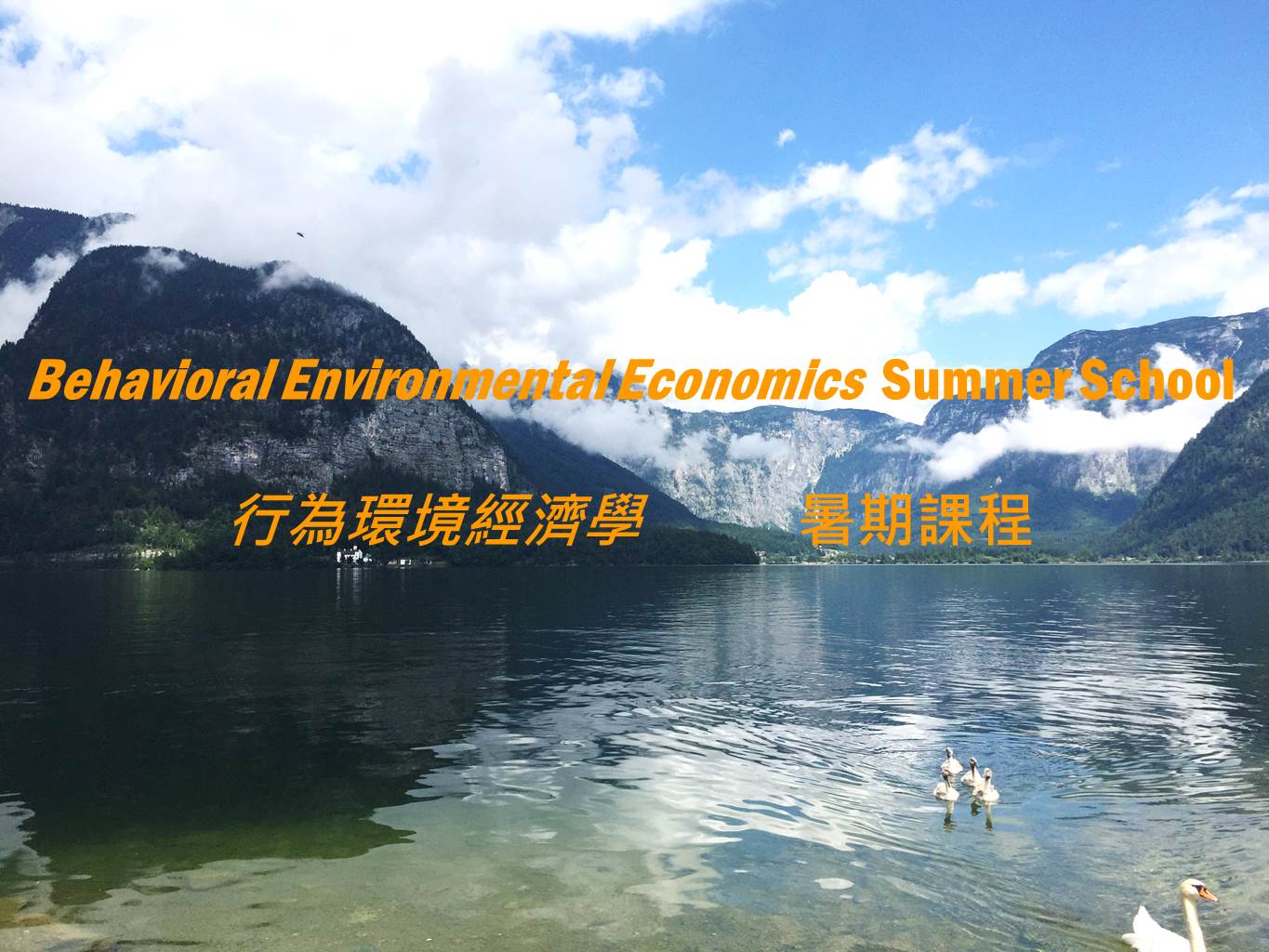
Behavioral Environmental Economics Summer School
August 30-31, 2018 in Taipei, Taiwan
Taiwan Association of Environmental and Resource Economics
Institute of Economics, Academia Sinica
Center for Global Change and Sustainability Science, National Taipei University
Institute of Nuclear Energy Research, Atomic Energy Council, Executive Yuan
DEADLINE FOR APPLICATIONS: August 15, 2018
The Taiwan Association of Environmental and Resource Economics (TAERE) and the Institute of Economics, Academia Sinica and the Center for Global Change and Sustainability Science, National Taipei University and Institute of Nuclear Energy Research, Atomic Energy Council, Executive Yuan are pleased to announce the first TAERE Summer School in Environmental and Resource Economics for students, researchers and professionals.
The School will take place from August 30 to 31 at the Institute of Economics, Academia Sinica in Taipei, Taiwan. The main theme covered by the 2018 Summer School is Behavioral Environmental Economics.
Normative environmental analyses based on the efficiency and cost-benefit criterion at times implied unambiguous policy treatments of environmental problems. However, standard policy instruments such as the Pigovian tax recommended by the environmental and public economists were often unpopular. Aggressive policy actions against climate change also often met with a cold acceptance. Citizens’ assessment of the riskiness of many environmental issues also diverged from many “objective” risk measures for them. While some of these divergences could be explained by the disparity between the individual interest and the collective social interest, or by concerns about the potential re-distributional effects of some “efficient” policies, modern behavioral economics has found abundant evidence that individuals’ preferences may not be so narrowly defined as in the standard economic theory. And these findings about human nature could have profound implications on the design of environmental policies. The aim of TAERE 2018 Summer School is to provide participants with a comprehensive picture of behavioral economics applied to the environmental issues and the basic toolkit required to conduct relevant researches. Therefore, the topics of the 2018 Summer School include:
- Behavioral economics and the environmental issues: Overview of the current and potential role of behavioral findings in environmental economics and policy, with specific reference to the incompatibility between the predictions of the standard economic theory and observed behaviors (e.g., sunk cost fallacy, status quo bias, anchoring, fungibility and mental accounting).
- Reference dependent preferences: Environmental valuations and the empirical evidence of “nonstandard” preferences (e.g., reference dependent preferences like loss aversion and the observed disparities between valuations of gains and losses; disparities between the Willingness-to-Pay and the Willingness-to-Accept). Policy implications will be discussed.
- Intertemporal choice in the perspectives from the behavioral theories: Intertemporal preferences and discounting values of future outcomes (e.g., exponential and hyperbolic discounting; present bias and commitment devices; reference dependence and discounting of future gains and future losses).
- Fairness and social preferences: E.g., altruism, trust and reciprocity, and social norms; empirical findings and policy implications.
- “Where are we going?”: Potential role and limitations of behavioral findings and policy design; possible future priorities/directions for environmental behavioral economics.
The course will be presented in lectures supplemented by small group exercises on chosen topics.
INSTRUCTORS
Jack L. Knetsch, Simon Fraser University, Canada
Y. Eko Riyanto, Nanyang Technological University, Singapore
PARTICIPATION FEE
The fee covers lecturer expenses, downloadable course material, morning and afternoon teas, and two lunches and one dinner included in the School programme. It does not cover accommodations.
- TAERE members: Free of charge (to become a member)
- Non-members: The participation fee is 100 USD (or 3,000 TWD) per person for non-members.
ADMISSION
The Summer School aims at graduate students, postdocs, academic and policy researchers, and professionals from all levels with an interest in behavioral economics and environmental economics.
Summer School Program. Here
Reading list. Here
This summer school will issue a certificate of attendance to a registered participant who attends all courses.
Information on how to apply are available on the Summer School website.
Summer School Secretariat: Email住址會使用灌水程式保護機制。你需要啟動Javascript才能觀看它.